Lead Casting
From recovered battery to precision-engineered casting. A complete, responsible, UK supply chain.
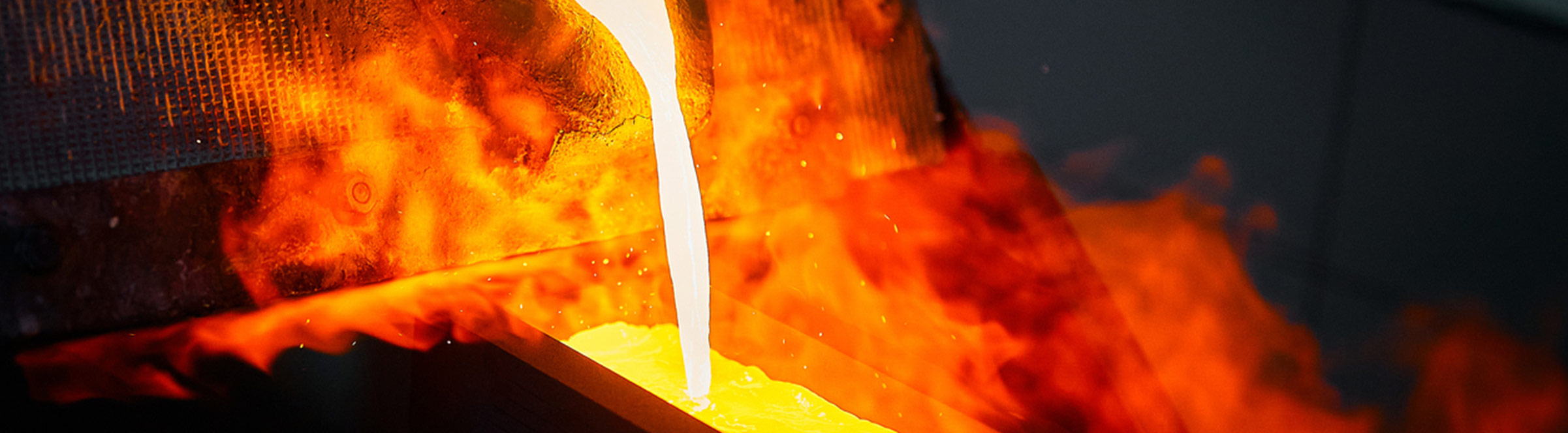
Lead casting is at the heart of what Royston Lead does and what sets us apart is where that process begins. The lead we cast starts a journey that begins with recovery, recycling and refining, and ends with a precision-engineered product delivered to a defined specification.
From recovered lead-acid batteries processed by our sister company Envirowales, through in-house refining and alloying, to cast ingots, shaped blanks and fully machined components. Our casting capability is a complete, traceable, end-to-end process. Built for the industries where the material provenance, metallurgical integrity and dimensional accuracy of a lead casting are not optional extras, they are the requirement.
Getting the Metal Right Before We Cast It.
The integrity of any lead casting is determined long before the metal reaches the mould. It is determined by the purity of the refined lead and the precision of the alloy composition.
Where the casting requirement is for commercially pure lead, we work with high-purity material produced to EN 12588 or equivalent specification. Where the application calls for an alloyed grade to achieve specific hardness, machinability, corrosion resistance, or mechanical performance, our technical team compounds the required alloy from the refined bullion to the customer’s specification or our own proven formulations.
Common Lead Alloy Systems for Casting
The alloy composition of a lead casting determines how it behaves during manufacture and throughout its service life. Our technical team works with customers to identify and specify the correct alloy for the application. Common alloy systems we work with include:
- Antimonial lead (Pb-Sb) — the addition of antimony increases hardness, improves machinability, and reduces thermal creep. Antimonial grades are widely specified for castings that will be further machined, and for applications where dimensional stability under load is important. Antimony content is typically 1–10% depending on the requirement.
- Tin-lead alloys (Pb-Sn) — tin addition improves corrosion resistance, castability and ductility. Used in castings where solderability or specific corrosion performance is required.
- Calcium-lead alloys (Pb-Ca) — low antimony, good creep resistance. Used in specific battery and industrial applications.
- High-purity lead (Pb) — for applications where alloy additions would compromise radiation attenuation performance, or where the chemical environment requires the highest material purity. Typically, 99.94% or 99.97% Pb minimum.
We treat alloy selection as part of the engineering conversation, not an afterthought.
Cast, Then Machined to the Tolerances Your Application Demands.
“Casting gives you the shape. Machining gives you the precision. For the most demanding applications be that: nuclear, defence, medical and precision industrial.”
For applications where as-cast dimensional accuracy is insufficient, or where the surface finish, bore geometry, thread form or assembly interfaces require close engineering tolerances, we can provide a CNC machine finish.
Lead and lead alloys require specific machining practice. Pure lead is soft and prone to smearing, requiring careful tool geometry and cutting speeds to achieve acceptable surface finishes. Antimonial alloys are more amenable to machining, producing sharper features and better surface finish.
What We Can Machine
- Precision bores, counterbores and internal features to close diameter tolerances
- Flat faces and parallel surfaces for assembly interfaces and seating faces
- External profiles, stepped diameters and turned features
- Threaded features, both internal and external
- Milled slots, pockets and external form features
Where Our Cast Lead Products Perform.
Our casting capability serves some of the most technically demanding markets in the world.
Nuclear
Lead’s combination of high density and gamma radiation attenuation makes it the material of choice for a broad range of nuclear shielding applications. Cast lead is used in the manufacture of shielding flasks, transport containers, storage vessels, hot cell components, pipe shielding collars, lead pots for isotope handling, and bespoke enclosures for radiation sources.
In nuclear applications, material traceability and casting quality are paramount. Our ability to supply fully traceable lead castings with documented chain of custody from recycled raw material to finished product is a significant advantage in the nuclear supply chain, where material provenance is subject to regulatory scrutiny. For the most demanding nuclear applications, we can produce castings to customer-specified quality plans and supply with the documentation packages their QA processes require.
Defence
Defence applications of cast lead span: radiation shielding, ballistic and blast attenuation components, counterweights and ballast amongst other applications.
Our quality management system, ISO 9001 accreditation, and in-house alloy control give us the discipline and the documentation capability to support defence supply chains. We are experienced in working to customer-specific quality requirements and in supplying the certification packages that contracts demand.
Industrial & Chemical
In industrial and chemical processing environments, lead’s outstanding resistance to corrosion by sulphuric acid and many other aggressive media makes it an enduring material choice for process equipment components, tank and vessel fittings, pump components, and marine applications.
We also supply lead ingots as feedstock to our own downstream equipment or to customers who carry out their own secondary processing, including rolling, extrusion and further casting providing a reliable, traceable, quality-assured supply of refined and alloyed lead to support their manufacturing operations.
Radiation Shielding — Medical & Research
In clinical and research environments, cast lead components are used in the construction of X-ray rooms, radiotherapy bunkers, nuclear medicine facilities, PET/CT suites and research reactor shielding. Castings range from standard lead bricks and interlocking shielding elements to complex bespoke components cast to architects’ or medical physicists’ drawings.
The requirements in medical and research shielding applications typically combine geometric complexity with strict density requirements. Since shielding performance is directly related to lead density, internal voids in a casting are not acceptable. Our casting process, allied to appropriate alloy selection and controlled pouring practice, consistently delivers the density and dimensional accuracy that shielding design calculations depend upon.
When Your Lead Casting Reaches the End of Its Service Life, We Can Take It Back.
The cradle-to-cradle loop does not end when we deliver your casting. Through our group relationship with Envirowales, we can offer customers a genuine end-of-life recovery pathway ensuring it is reprocessed responsibly rather than entering the waste stream.
For customers with corporate sustainability commitments, or who operate in sectors where responsible material stewardship is a regulatory or reputational requirement, this end-of-life service is a tangible benefit.
Talk to us about how we can structure a supply and recovery arrangement that supports your sustainability goals.
get in touch
Have questions or need specialist guidance?
Our team at Royston Lead is here to provide expert advice and help you find the right high-spec lead solution. Get in touch today.
Call Support